
AI + Healthcare, Part 2: What Happens When the Product Keeps Changing After Approval?
FDA approval is not the end of the regulatory or commercial journey for AI-enabled healthcare products. This article examines what happens when AI changes a medical device, diagnostic tool or clinical software platform after approval—and how companies should manage regulatory review, reimbursement, accountability and investor expectations.
The harder regulatory question may begin after FDA clearance or approval.
A medical device, diagnostic tool or clinical software platform may reach the market based on one version of its technology. The company then uses AI to improve performance, identify new patterns, reduce false positives or expand the product’s usefulness.
That creates a new practical question for leadership: when is an update still part of the approved product, and when has the company created something that needs another regulatory review?
A conventional medical product usually stays recognizable after approval. Its manufacturer may improve the design, but providers, payers and regulators can still identify the product they evaluated and compare the changes against the earlier version.
AI-enabled software can change things more quietly. A new training set, algorithm or software release may alter the product’s recommendations without changing its outward appearance. The company’s process for managing those changes therefore should become part of its regulatory strategy.
For example, an update that fixes a technical problem may raise different questions from one that changes the product’s intended use, clinical claims, risk profile or method of operation. A diagnostic tool that becomes capable of identifying a different condition, guiding a new treatment decision or serving a broader patient population may require more than ordinary maintenance.
Executives should establish those boundaries before the product reaches the market. Waiting until an engineering team has completed a major update can leave the company trying to answer regulatory questions after the commercial decision has already been made.
Approval does not end the regulatory work
AI development often follows a continuous cycle. Teams release improvements in response to new data, customer feedback and performance testing. FDA review, however, is based on defined submissions and defined evidence.
A company needs a practical plan for what happens next. It should know which changes can be handled through an established change-control process, which require additional validation and which may require a new submission. It should also be able to show how the updated product performs across the populations and care settings where it will be used.
This does not require companies to abandon rapid development. It requires technical, clinical and regulatory teams to make decisions together before an update is released.
Payment and adoption create a second gate
FDA authorization allows a product to be marketed under the applicable rules. It does not guarantee coverage, payment or adoption.
An AI update may improve accuracy or expand the number of patients who can benefit. A payer may still ask whether the change improves outcomes, lowers total cost or simply produces a more sophisticated recommendation.
Hospitals may ask whether the update changes workflow, documentation, staffing or liability. Health plans may ask whether the revised product fits within an existing coverage category or requires new evidence.
A company that treats reimbursement as a post-approval issue may discover that its commercial plan has not kept pace with its regulatory progress.
Responsibility follows the update
Leadership also needs a clear answer to a basic question: who is responsible when the product changes?
That answer depends on how the company tests and validates each release, notifies providers and customers, maintains version records and manages human review.
It also depends on cybersecurity, data governance and the contracts that allocate responsibility among the developer, provider and health system.
If the system produces a different result after receiving new data, the company should be able to explain what changed, why it changed and how the revised performance was evaluated.
That is a business requirement as much as a legal one.
The investment question
Investors may see continuous AI improvement as a competitive advantage. They may also ask whether the company has the systems needed to manage continuing FDA, reimbursement, quality and liability obligations.
A company that can show disciplined product governance may be better positioned than one that treats every update as a software release with no regulatory consequences. The quality of that governance can affect launch timing, contracting, payer discussions and investor confidence.
The central issue is not whether AI should continue improving after approval. It should.
The issue is whether the company has built a process that allows improvement without losing track of authorization, evidence, payment and accountability.
FDA approval marks an important milestone. For an AI-enabled product, it may also mark the beginning of a more demanding operating phase.
The companies most likely to succeed will connect engineering, regulatory, clinical, reimbursement and legal decisions before an update reaches the market.
That is the real test for healthcare AI should not be simply whether the product can learn, but whether the company can govern what it learns.
This is the second article in a series examining artificial intelligence through healthcare, regulation, reimbursement, capital and the institutions that determine whether innovation reaches patients.
Lanton Strategies International advises healthcare and life-sciences companies on U.S. market entry, policy, reimbursement, regulatory strategy and commercial risk. Lanton, Lanton & Sosa Law PLLC provides legal counsel to regulated healthcare organizations, associations and businesses.
This article is provided for general educational and informational purposes only. It is not legal advice and does not create an attorney-client relationship. Readers should consult qualified counsel about their specific circumstances.
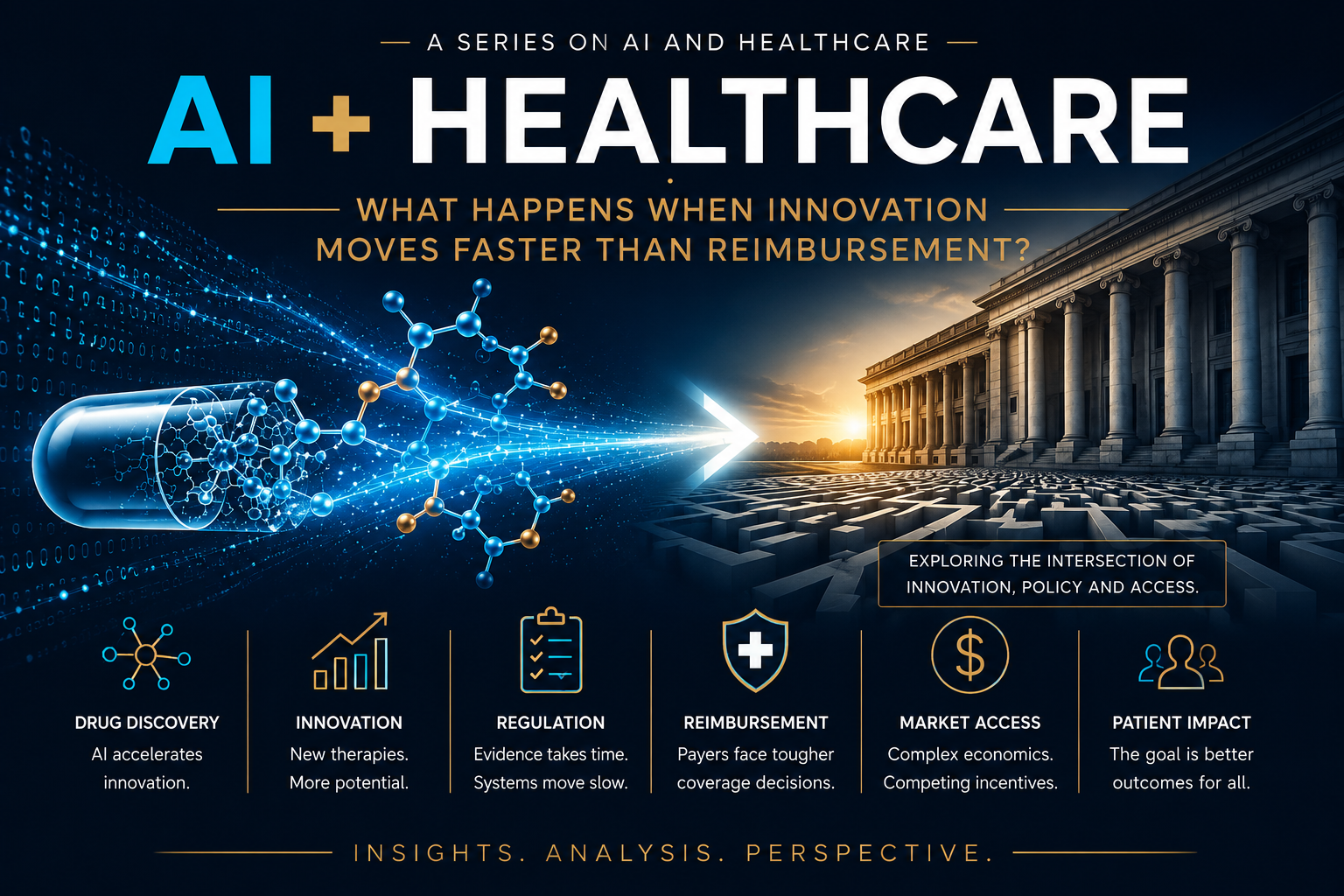
What Happens When AI Develops Drugs Faster Than Insurers Can Figure Out How to Pay for Them?
Artificial intelligence could accelerate drug development, but the healthcare payment system was built to move much more slowly. Using Sovaldi as an early example of what happens when breakthrough innovation collides with reimbursement, Ron Lanton examines whether insurers and other healthcare institutions are prepared for an AI-driven drug pipeline.
In 2013, Sovaldi gave the healthcare system a glimpse of what happens when medical innovation moves faster than the system designed to pay for it.
The drug changed the treatment of hepatitis C. Patients who once faced years of chronic disease suddenly had access to a therapy capable of curing it in a matter of weeks.
Then came the price.
A typical 12-week course cost $84,000.
The debate that followed was not simply about whether Sovaldi worked. Payers had to determine how to cover an expensive breakthrough therapy for a large patient population while operating within existing budgets, formularies, and utilization controls.
More than a decade later, artificial intelligence could create a much bigger version of that problem.
AI is beginning to play a role throughout drug development. It can help identify targets, generate potential molecules, optimize candidates, analyze data, and potentially shorten parts of a process that has traditionally taken years.
That is exciting, but it also exposes a weakness in the healthcare system.
Our ability to create new therapies may eventually begin moving faster than our ability to figure out how to pay for them.
Healthcare reimbursement was built to move carefully. Insurers rely on formularies, pharmacy and therapeutics committees, prior authorization, contracting, benefit design, and annual budgeting. Government programs operate through their own regulatory and budget processes.
There are good reasons for that structure. Evidence has to be reviewed and healthcare spending is not unlimited.
The problem is that the system was built around a relatively slow innovation cycle.
AI could change that cycle without changing the institutions surrounding it.
If AI allows more promising therapies to move through development, insurers may face more coverage decisions, potentially arriving faster and involving products with very different economics.
Sovaldi showed us how difficult one major therapeutic breakthrough could be for the payment system.
AI could make that challenge more common.
There is another issue that AI does not solve.
A treatment may save the healthcare system enormous amounts of money over time while still creating an immediate problem for the payer covering it today.
Imagine a therapy that costs $150,000 but prevents $500,000 in medical expenses over the next 15 years.
That may make sense from a societal perspective.
The insurer paying the $150,000 today may not cover that patient five years from now. An employer may change health plans. A Medicaid patient may move into another program. Medicare may eventually become responsible for that patient’s care.
The organization paying for the innovation may never capture much of the savings it creates.
AI could make drug discovery more efficient. That does not automatically mean drugs will become cheaper, and it does not fix the way we finance long-term value.
That may become one of the most important healthcare questions surrounding AI.
We spend a lot of time talking about what artificial intelligence may allow us to create.
We should also be thinking about whether the institutions surrounding healthcare can keep up with what we create.
Sovaldi forced the system to confront that problem one breakthrough drug at a time.
AI could force us to confront it across the entire system.
This is the first in a series looking at artificial intelligence through healthcare, regulation, reimbursement, capital, and the institutions that ultimately determine whether innovation reaches patients.

Where AI Happens: Governance, Infrastructure, and the New Geography of Innovation
Artificial intelligence is often framed as a race for talent and capital. Increasingly, it is becoming something else: a function of governance, infrastructure, and policy alignment.
For years, conversations about artificial intelligence centered on capability. The focus was on who could build advanced systems, who had access to meaningful data, and who could scale those systems efficiently.
Those factors still matter. They no longer tell the full story.
A different layer is beginning to shape the AI economy. It has less to do with the models themselves and more to do with where those models can be deployed and sustained over time.
Artificial intelligence systems require more than code. They depend on computing capacity, consistent access to energy, and regulatory environments that allow them to operate at scale. Each of these conditions is increasingly influenced by policy.
In Europe, the expansion of AI infrastructure is already placing pressure on traditional electrical grids. Some data centers are now being designed around dedicated microgrid systems capable of supporting large-scale operations. What once appeared to be a background constraint is becoming a primary determinant of where AI systems can function reliably.
Energy is no longer simply an input. It is becoming a gating factor.
Governance is evolving in parallel.
In the United States, there is a growing push to establish a national framework for artificial intelligence, in part to reduce fragmentation created by state-level regulatory approaches. This effort is often described as coordination. It also reflects a deeper question about where authority should sit.
A system shaped by multiple state laws would create a patchwork of compliance complexity. A more centralized federal structure would produce a different set of incentives.
Governance is not yet settled. It is still forming.
Companies are making deployment decisions within that uncertainty. Some are moving cautiously. Others are moving where the rules appear more defined, even if those rules are more restrictive.
Capital responds to those signals. It does not wait for full clarity. It tends to move toward environments that appear more durable or strategically aligned.
Over time, those decisions begin to shape where activity concentrates.
This is how geography starts to take shape.
It is not driven solely by talent or capital. It emerges from the interaction between infrastructure and policy.
The contrast with Europe is instructive. The European Union has adopted a more precautionary model, emphasizing risk classification and oversight. The United States appears to be moving toward a framework that places greater weight on alignment and acceleration, even as that framework continues to develop.
These approaches create different operating environments.
Over time, those environments influence outcomes. Certain technologies scale more easily in one jurisdiction than another. Certain applications face more constraints. Companies adjust accordingly, often in ways that reflect policy conditions as much as market demand.
For companies operating across healthcare, life sciences, and advanced technologies, these differences are no longer abstract. Decisions about where to build infrastructure, where to deploy systems, and where to allocate capital are increasingly tied to policy alignment.
This reflects a broader shift taking place across sectors.
Artificial intelligence is no longer just a technological frontier. It is becoming part of industrial policy.
That shift changes how innovation unfolds. It is no longer sufficient to ask what is possible. The more relevant question is where that possibility can be supported, sustained, and scaled.
Innovation tends to follow those conditions.
That is what is beginning to reshape the geography of innovation.