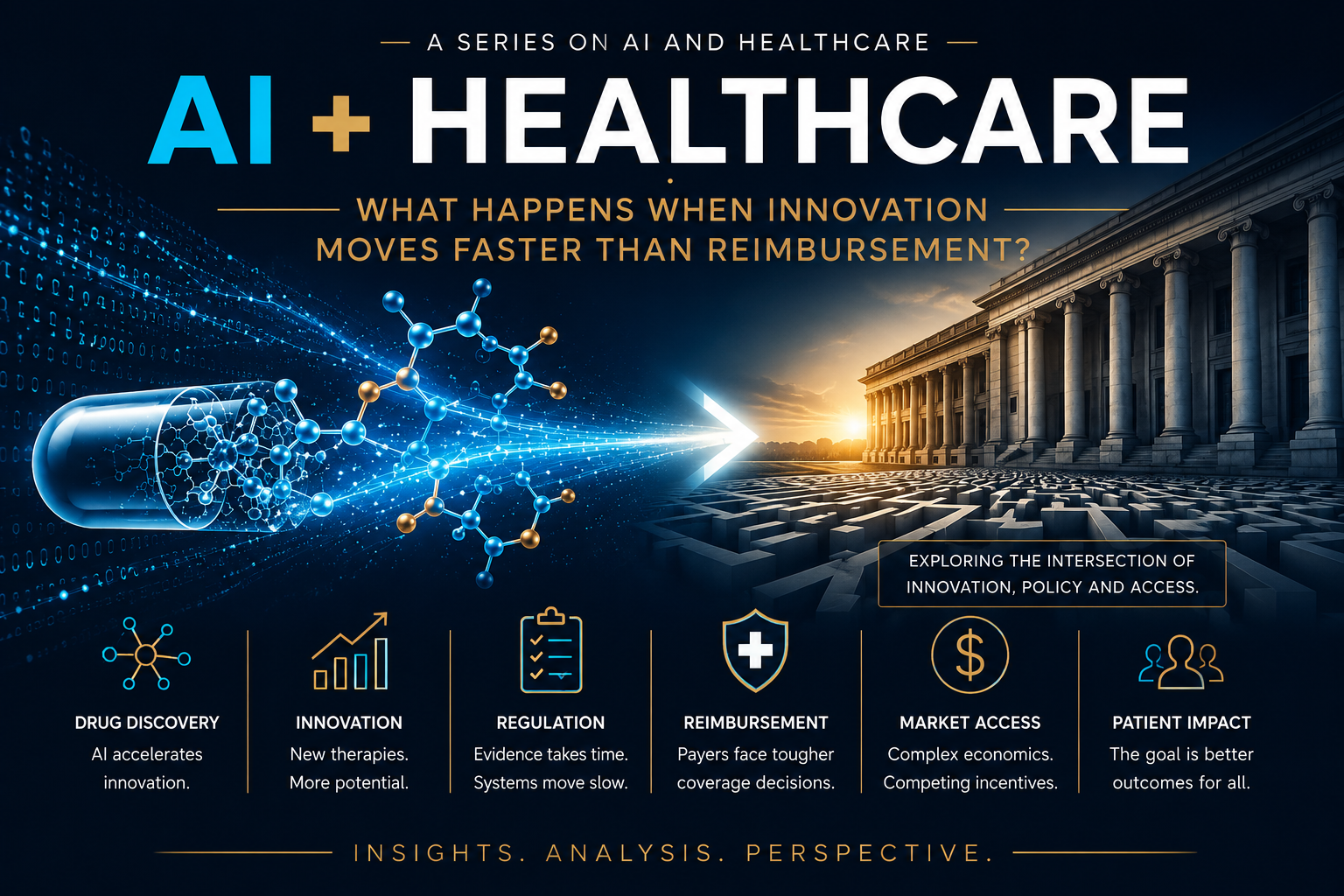
What Happens When AI Develops Drugs Faster Than Insurers Can Figure Out How to Pay for Them?
Artificial intelligence could accelerate drug development, but the healthcare payment system was built to move much more slowly. Using Sovaldi as an early example of what happens when breakthrough innovation collides with reimbursement, Ron Lanton examines whether insurers and other healthcare institutions are prepared for an AI-driven drug pipeline.
In 2013, Sovaldi gave the healthcare system a glimpse of what happens when medical innovation moves faster than the system designed to pay for it.
The drug changed the treatment of hepatitis C. Patients who once faced years of chronic disease suddenly had access to a therapy capable of curing it in a matter of weeks.
Then came the price.
A typical 12-week course cost $84,000.
The debate that followed was not simply about whether Sovaldi worked. Payers had to determine how to cover an expensive breakthrough therapy for a large patient population while operating within existing budgets, formularies, and utilization controls.
More than a decade later, artificial intelligence could create a much bigger version of that problem.
AI is beginning to play a role throughout drug development. It can help identify targets, generate potential molecules, optimize candidates, analyze data, and potentially shorten parts of a process that has traditionally taken years.
That is exciting, but it also exposes a weakness in the healthcare system.
Our ability to create new therapies may eventually begin moving faster than our ability to figure out how to pay for them.
Healthcare reimbursement was built to move carefully. Insurers rely on formularies, pharmacy and therapeutics committees, prior authorization, contracting, benefit design, and annual budgeting. Government programs operate through their own regulatory and budget processes.
There are good reasons for that structure. Evidence has to be reviewed and healthcare spending is not unlimited.
The problem is that the system was built around a relatively slow innovation cycle.
AI could change that cycle without changing the institutions surrounding it.
If AI allows more promising therapies to move through development, insurers may face more coverage decisions, potentially arriving faster and involving products with very different economics.
Sovaldi showed us how difficult one major therapeutic breakthrough could be for the payment system.
AI could make that challenge more common.
There is another issue that AI does not solve.
A treatment may save the healthcare system enormous amounts of money over time while still creating an immediate problem for the payer covering it today.
Imagine a therapy that costs $150,000 but prevents $500,000 in medical expenses over the next 15 years.
That may make sense from a societal perspective.
The insurer paying the $150,000 today may not cover that patient five years from now. An employer may change health plans. A Medicaid patient may move into another program. Medicare may eventually become responsible for that patient’s care.
The organization paying for the innovation may never capture much of the savings it creates.
AI could make drug discovery more efficient. That does not automatically mean drugs will become cheaper, and it does not fix the way we finance long-term value.
That may become one of the most important healthcare questions surrounding AI.
We spend a lot of time talking about what artificial intelligence may allow us to create.
We should also be thinking about whether the institutions surrounding healthcare can keep up with what we create.
Sovaldi forced the system to confront that problem one breakthrough drug at a time.
AI could force us to confront it across the entire system.
This is the first in a series looking at artificial intelligence through healthcare, regulation, reimbursement, capital, and the institutions that ultimately determine whether innovation reaches patients.

Where AI Happens: Governance, Infrastructure, and the New Geography of Innovation
Artificial intelligence is often framed as a race for talent and capital. Increasingly, it is becoming something else: a function of governance, infrastructure, and policy alignment.
For years, conversations about artificial intelligence centered on capability. The focus was on who could build advanced systems, who had access to meaningful data, and who could scale those systems efficiently.
Those factors still matter. They no longer tell the full story.
A different layer is beginning to shape the AI economy. It has less to do with the models themselves and more to do with where those models can be deployed and sustained over time.
Artificial intelligence systems require more than code. They depend on computing capacity, consistent access to energy, and regulatory environments that allow them to operate at scale. Each of these conditions is increasingly influenced by policy.
In Europe, the expansion of AI infrastructure is already placing pressure on traditional electrical grids. Some data centers are now being designed around dedicated microgrid systems capable of supporting large-scale operations. What once appeared to be a background constraint is becoming a primary determinant of where AI systems can function reliably.
Energy is no longer simply an input. It is becoming a gating factor.
Governance is evolving in parallel.
In the United States, there is a growing push to establish a national framework for artificial intelligence, in part to reduce fragmentation created by state-level regulatory approaches. This effort is often described as coordination. It also reflects a deeper question about where authority should sit.
A system shaped by multiple state laws would create a patchwork of compliance complexity. A more centralized federal structure would produce a different set of incentives.
Governance is not yet settled. It is still forming.
Companies are making deployment decisions within that uncertainty. Some are moving cautiously. Others are moving where the rules appear more defined, even if those rules are more restrictive.
Capital responds to those signals. It does not wait for full clarity. It tends to move toward environments that appear more durable or strategically aligned.
Over time, those decisions begin to shape where activity concentrates.
This is how geography starts to take shape.
It is not driven solely by talent or capital. It emerges from the interaction between infrastructure and policy.
The contrast with Europe is instructive. The European Union has adopted a more precautionary model, emphasizing risk classification and oversight. The United States appears to be moving toward a framework that places greater weight on alignment and acceleration, even as that framework continues to develop.
These approaches create different operating environments.
Over time, those environments influence outcomes. Certain technologies scale more easily in one jurisdiction than another. Certain applications face more constraints. Companies adjust accordingly, often in ways that reflect policy conditions as much as market demand.
For companies operating across healthcare, life sciences, and advanced technologies, these differences are no longer abstract. Decisions about where to build infrastructure, where to deploy systems, and where to allocate capital are increasingly tied to policy alignment.
This reflects a broader shift taking place across sectors.
Artificial intelligence is no longer just a technological frontier. It is becoming part of industrial policy.
That shift changes how innovation unfolds. It is no longer sufficient to ask what is possible. The more relevant question is where that possibility can be supported, sustained, and scaled.
Innovation tends to follow those conditions.
That is what is beginning to reshape the geography of innovation.